
Planning permission for loft conversions in London: complete 2026 guide
Do you need planning permission for a loft conversion in London? Complete 2026 guide covering permitted development, conservation areas, Article 4 zones, costs and timelines.
How to use this guide
- Read with your project scope and budget envelope in mind.
- Use it to brief designers and compare quotations more rigorously.
- Raise any project-specific constraints with us before committing to a contractor.
Do I Need Planning Permission for a Loft Conversion in London? The Complete 2026 Guide
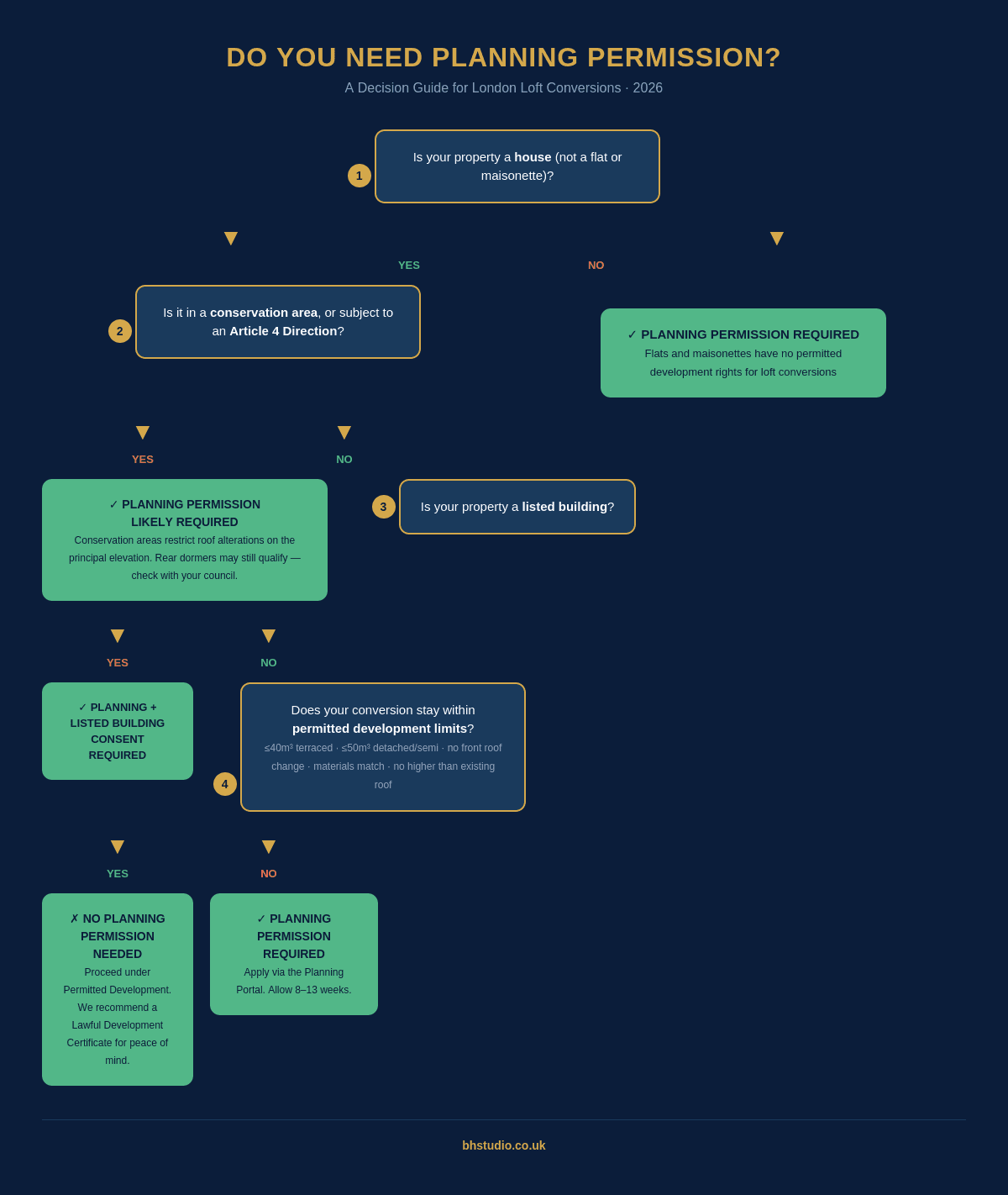
Most loft conversions in London do not need planning permission. If your property is a house (not a flat), is not in a conservation area or Article 4 Direction zone, and your conversion stays within permitted development limits - 40 cubic metres for terraced houses or 50 cubic metres for detached and semi-detached homes - you can proceed without a planning application. However, London has over 1,000 conservation areas, and many boroughs including Islington, Hackney, and Camden have extensive Article 4 Directions that remove permitted development rights. If your property falls into any of these categories, you will need full planning permission, which costs £528 for a householder application (as of April 2025) and takes 8–13 weeks for a council decision. Regardless of planning permission status, all loft conversions require building regulations approval and most London terraced homes will need party wall agreements.
Key Takeaways
1. Most London houses qualify for permitted development - you can convert your loft without planning permission if you stay within volume limits (40m³ terraced, 50m³ detached/semi) and follow design rules around materials, dormer placement, and roof height.
2. Conservation areas and Article 4 Directions change everything - London has more than 1,000 conservation areas. If your home is in one, you will almost certainly need full planning permission for any roof alterations.
3. Flats and maisonettes always need planning permission - there are no permitted development rights for loft conversions to flats, regardless of location.
4. The householder planning application fee doubled in 2025 - it rose from £258 to £528 in April 2025, and will increase annually with inflation going forward.
5. Building regulations are required regardless - even if you do not need planning permission, every loft conversion must pass building control inspections covering structural integrity, fire safety, insulation, and staircase design.
6. A design-and-build firm handles the entire process - Better Homes manages planning applications, building regulations, structural engineering, and party wall agreements as part of our full-service loft conversion package across East, North, and Central London.
The Short Answer - Do Most London Loft Conversions Need Planning Permission?
For the majority of London homeowners living in standard houses - terraced, semi-detached, or detached - the answer is no. Most loft conversions fall under what the government calls permitted development rights, a scheme designed to allow homeowners to extend and improve their properties without the cost and delay of a formal planning application.
Permitted development was introduced to streamline the process for sensible, small-scale home improvements. For loft conversions specifically, it means you can add a rear dormer, install rooflights, or carry out a hip-to-gable conversion without needing council approval - provided you stay within strict volume, design, and material limits.
However, London is not a straightforward city when it comes to planning. With over 1,000 conservation areas, dozens of Article 4 Direction zones, and thousands of listed buildings, the capital has more planning restrictions per square mile than anywhere else in the UK. The borough you live in, the street your house is on, and even the direction your roof faces can all determine whether you need a full planning application or not.
That is precisely why this guide exists. At Better Homes, we have managed loft conversions across Hackney, Islington, Walthamstow, Muswell Hill, Crouch End, and Finchley - boroughs where conservation areas, Victorian housing stock, and varying council attitudes create a uniquely complex planning landscape. We have written this guide to give London homeowners the most comprehensive, borough-specific planning resource available.
Permitted Development Rights for Loft Conversions: The Exact 2026 Rules
Permitted development rights for loft conversions are set out in Schedule 2, Part 1, Class B of the Town and Country Planning (General Permitted Development) (England) Order 2015, as amended. These are national rules - they apply in every London borough - but local authorities can restrict or remove them through conservation area designations and Article 4 Directions.
To proceed without planning permission, your loft conversion must meet every one of the following criteria. Failing even one means you will need a full householder planning application.
Volume Limits
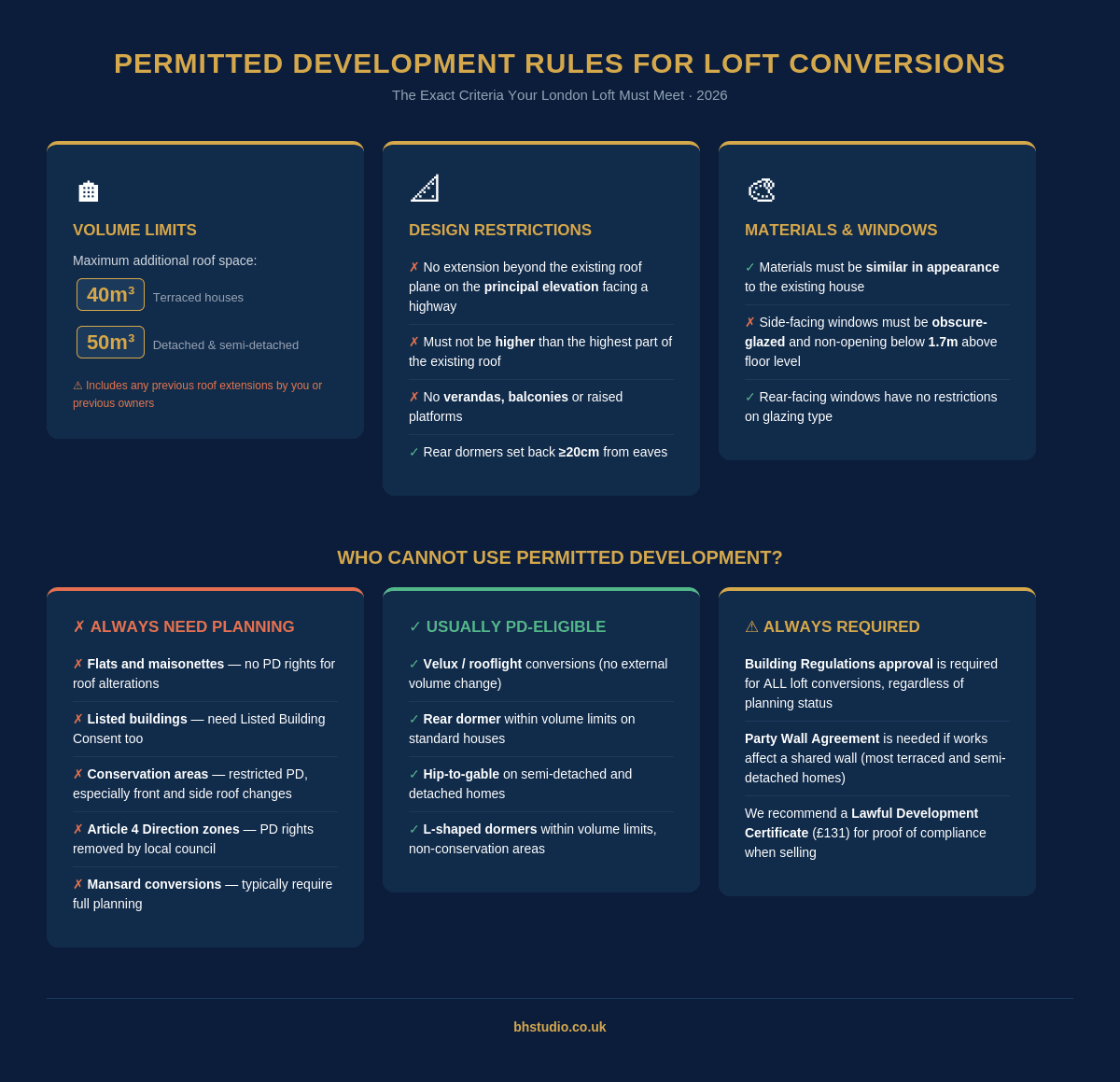
The total additional roof space created by your loft conversion must not exceed 40 cubic metres for terraced houses or 50 cubic metres for detached and semi-detached homes. This is the single most important number in the permitted development calculation. Crucially, these volume allowances are cumulative - they include any previous roof extensions carried out by you or by previous owners since the house was originally built (or since 1 July 1948, whichever is later). If a previous owner added a small rear dormer that used 15 cubic metres, your remaining allowance on a terraced house would be just 25 cubic metres. Your loft conversion specialist should always check the planning history before assuming you have the full allowance available.
Design and Placement Restrictions
The conversion must not extend beyond the plane of the existing roof slope on the principal elevation facing a highway. In practical terms, this means you cannot add a dormer to the front of your house under permitted development - front-facing dormers almost always need planning permission in London. The conversion must not be higher than the highest part of the existing roof, and any rear dormer must be set back at least 20 centimetres from the original eaves, measured along the plane of the roof. No verandas, balconies, or raised platforms are permitted. These restrictions are designed to minimise the visual impact on the streetscape, which is why rear dormers are by far the most common type of loft conversion carried out under permitted development in London.
Materials and Windows
Materials used in the conversion must be similar in appearance to the existing house. This means matching roof tiles, cladding finishes, and render colours. Any side-facing windows must be obscure-glazed and either fixed shut or have openings at least 1.7 metres above the internal floor level. This is a privacy measure - particularly relevant in London where terraced and semi-detached properties are built close together. Rear-facing windows have no such restrictions on glazing type or opening mechanism.
When You Always Need Planning Permission in London
While permitted development covers the majority of standard loft conversions, there are several categories of property and location where planning permission is always required. London, given its density, heritage, and architectural diversity, has a disproportionately high number of properties that fall into these categories.
Conservation Areas
Conservation areas are designated by local councils to protect areas of special architectural or historic interest. London has over 1,000 of them - far more than any other UK city. Within a conservation area, permitted development rights for loft conversions are significantly restricted. You cannot make any alteration to the roof slope on a principal elevation or any elevation facing a highway. In many conservation areas, even rear dormers that would normally be permitted development require a full planning application. The specific restrictions vary by borough and by individual conservation area, which is why checking with your local planning authority is essential before assuming any rights apply. Islington, for example, has 27 conservation areas, and its council requires full planning permission for virtually all loft conversions that involve external changes to the roofline.
Article 4 Directions
An Article 4 Direction is a special planning order that allows a local council to remove specific permitted development rights in a defined area. Many London boroughs have implemented Article 4 Directions in their conservation areas and other sensitive locations to give themselves greater control over changes to properties. If your home is subject to an Article 4 Direction that specifically removes Class B rights (roof alterations), you will need full planning permission even for a small rear dormer that would otherwise qualify as permitted development. Article 4 Directions are not always obvious - they are not marked on the property itself - so you need to check your council's planning portal or contact the planning department directly. Better Homes checks this for every property we survey as part of our standard process.
Listed Buildings
If your property is a listed building (Grade I, Grade II*, or Grade II), you will need both full planning permission and listed building consent for any loft conversion work, regardless of its size or scope. Listed building consent is a separate application from planning permission and carries its own assessment criteria focused on preserving the building's historic and architectural significance. The application itself is free, but the professional fees for preparing a heritage impact assessment and detailed drawings can be substantial. London has approximately 19,000 listed buildings, and while the majority are in central London, there are significant numbers in the inner boroughs that Better Homes serves, including Islington, Hackney, and Camden.
Flats and Maisonettes
Permitted development rights for loft conversions apply only to houses. If you live in a flat or maisonette - whether a purpose-built block or a converted Victorian house divided into flats - you have no permitted development rights for roof alterations. You will need full planning permission, and you will also need the freeholder's consent and potentially the agreement of other leaseholders before any work can begin. This applies regardless of whether the property is in a conservation area or not. Given that a significant proportion of London's housing stock consists of converted flats, this is a particularly relevant restriction for homeowners in boroughs like Hackney and Islington.
Planning Rules by Loft Conversion Type
The type of loft conversion you choose has a direct impact on whether you need planning permission. Here is how each of the five main conversion types sits within the London planning framework.
Velux (Rooflight) Conversions
Velux conversions involve adding skylight windows to the existing roof slope without altering the external structure. Because they do not change the volume, height, or profile of the roof, they almost never require planning permission - even in conservation areas, provided no structural changes are made to the roof shape. This makes them the simplest and fastest type of conversion from a planning perspective. The trade-off is that they offer less additional headroom and usable floor space than a dormer or mansard conversion. In London, velux conversions are most commonly used in properties with generous existing loft height or as a cost-effective way to create a home office or additional bedroom.
Rear Dormer Conversions
The rear dormer is London's most popular loft conversion type. It extends vertically from the rear roof slope, creating a box-shaped structure that provides full standing headroom across the width of the new room. Most rear dormers fall comfortably within permitted development limits for standard houses outside conservation areas. As long as the dormer stays within the 40 or 50 cubic metre volume allowance, is set back at least 20cm from the eaves, uses matching materials, and does not extend beyond the existing roofline, no planning permission is needed. In conservation areas, however, rear dormers often require planning permission because the additional restrictions on roof alterations apply more broadly.
Hip-to-Gable Conversions
Hip-to-gable conversions are designed for semi-detached and detached homes with hipped (sloping) roofs. The conversion straightens the sloped end of the roof into a vertical gable wall, significantly increasing the usable loft space. These conversions are generally eligible for permitted development on standard houses outside conservation areas, provided the volume limits are respected. They are particularly popular in North London suburbs like Muswell Hill and Finchley, where Edwardian semi-detached homes with hipped roofs are the dominant housing type. In conservation areas, hip-to-gable conversions almost always require planning permission because they visibly alter the roofline when viewed from the side.
L-Shaped Dormer Conversions
L-shaped dormers combine a rear dormer with a side dormer or hip-to-gable extension, creating an L-shaped footprint that maximises usable loft space. They are common on end-of-terrace and semi-detached homes where there is an exposed side roof slope to work with. Planning requirements depend on the total volume of the conversion and whether the side-facing elements comply with permitted development rules. Because L-shaped dormers are larger, they are more likely to approach or exceed the 40 or 50 cubic metre limits, which means careful volume calculations are essential. If any part of the conversion exceeds permitted development criteria, the entire project requires planning permission.
Mansard Conversions
Mansard conversions involve altering the entire rear roof structure to create a near-vertical wall (typically 72 degrees) with a flat or gently sloping top. They offer the maximum possible floor space and are the most architecturally transformative type of loft conversion. Because of the extent of the structural changes involved, mansard conversions almost always require full planning permission in London - even outside conservation areas. Paradoxically, mansard conversions are sometimes the only type of loft conversion that conservation area planning officers will approve, because their design can be more sympathetic to traditional London rooflines than a box-shaped dormer. In Islington, for example, mansard designs are frequently the preferred approach in conservation zones because they maintain the borough's characteristic Georgian and Victorian streetscape proportions.
Conservation Areas and Article 4 Directions - A London-Specific Deep Dive
Conservation areas deserve their own detailed section because they affect more London homeowners than any other single planning restriction. Understanding how they work - and how they vary between boroughs - can save you months of delays and thousands of pounds in abortive design fees.
A conservation area is a legally designated zone where the local council has determined that the area's character and appearance should be preserved or enhanced. Within these areas, the council has additional powers to control development, including the ability to restrict permitted development rights for roof alterations. The first conservation areas in England were designated in 1967, and today there are approximately 10,000 across the country, with London accounting for more than 1,000 of them. Some London boroughs have more of their land covered by conservation area designations than not - Richmond upon Thames, for instance, has 72 conservation areas covering a substantial proportion of the borough.
For loft conversions, the most significant restriction in conservation areas is that no extension or alteration can be made to the roof slope on any elevation facing a highway. In practice, this means front dormers and side dormers visible from the street are almost always refused. Rear dormers may still be permissible under permitted development in some conservation areas, but many London councils have used Article 4 Directions to remove even this right. The only certain way to know what is permitted on your specific property is to check with your borough council's planning department.
Borough-by-Borough Planning Guide for East and North London
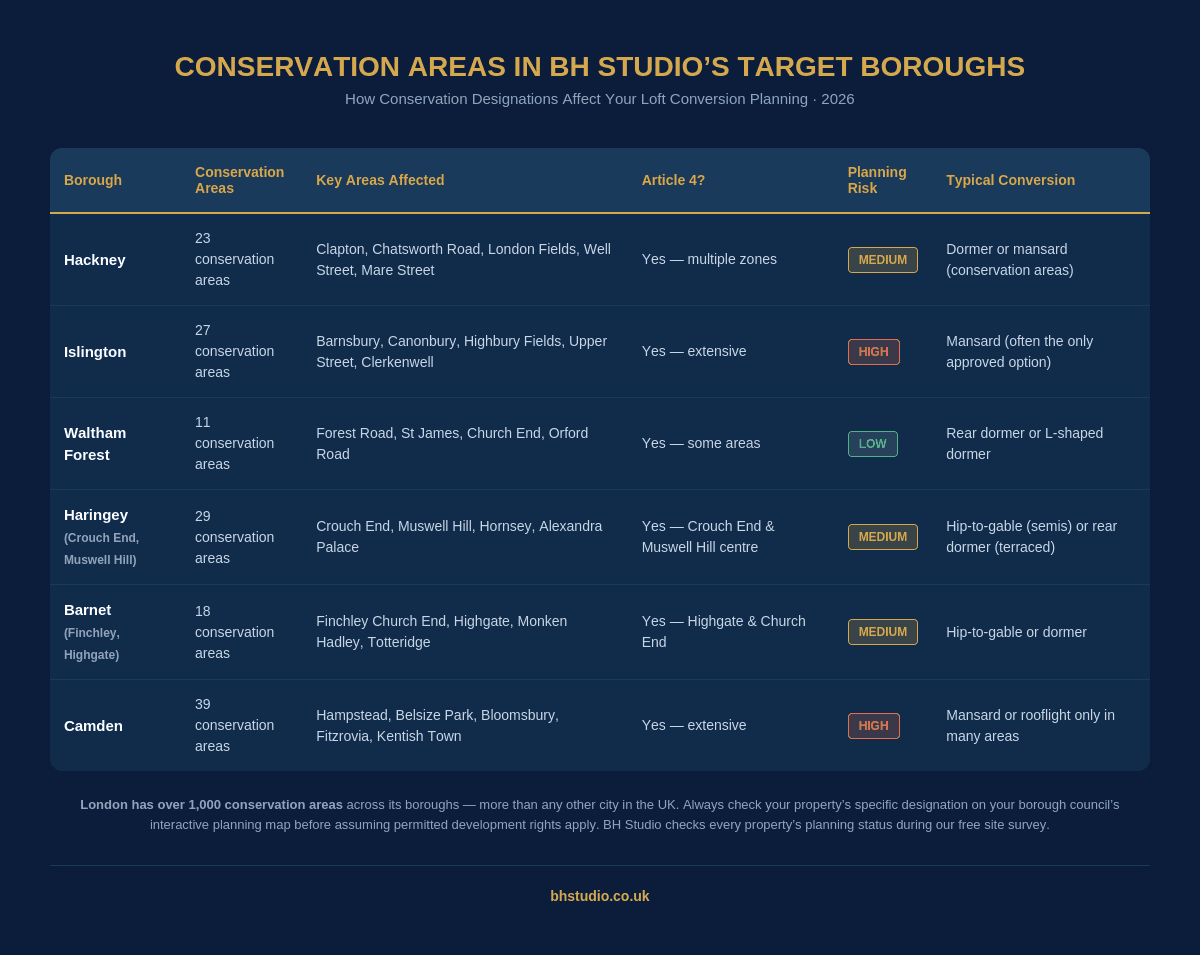
One of the most frustrating aspects of London's planning system is that rules can vary dramatically from one borough to the next. A loft conversion that proceeds smoothly under permitted development in Walthamstow might require a full planning application - and a heritage statement - just a few miles away in Islington. Here is what we have learned from managing conversions across our core service areas.
Hackney (E8, E9, E5)
Hackney has 23 conservation areas including Clapton, Chatsworth Road, London Fields, and Well Street. Outside these zones, most rear dormer conversions on Victorian terraced houses proceed under permitted development without difficulty. Inside conservation areas, the situation is more complex - Hackney Council generally requires full planning permission for any external roof changes, and mansard designs are often preferred for their sympathetic proportions. Hackney's housing stock is approximately 68% Victorian and Edwardian terraced, making dormer and L-shaped dormer conversions the most common types. With average property values around £550,000, a well-executed loft conversion in Hackney typically adds £110,000–£137,000 in value - a strong return on investment.
Islington (N1, N7, N5)
Islington is one of the most planning-restricted boroughs in London, with 27 conservation areas covering a significant proportion of its residential streets. The borough has extensive Article 4 Directions, and its planning officers apply strict design guidelines that require materials and proportions to match the existing property. For most Islington homeowners, a loft conversion will require full planning permission. Mansard conversions are frequently the only design that receives approval in Islington's conservation zones, particularly in areas like Barnsbury, Canonbury, and Highbury Fields. This is where Better Homes' full design-and-build model is particularly valuable - our in-house design team understands Islington Council's specific requirements and can prepare submissions that meet their expectations from the outset, avoiding costly redesigns.
Walthamstow (E17)
Walthamstow is a significantly easier planning environment than Hackney or Islington. Waltham Forest has 11 conservation areas - far fewer than its neighbours - and large parts of the E17 postcode have no conservation or Article 4 restrictions at all. The housing stock is predominantly Victorian terraced, and rear dormer conversions are the most popular type. Most E17 homeowners can proceed under permitted development for a standard rear dormer, making Walthamstow one of the fastest boroughs to get from initial design to construction start. The main planning consideration is checking whether your specific street is within the Forest Road, St James, or Church End conservation areas, where additional restrictions apply.
Muswell Hill and Crouch End (N10, N8)
Both areas sit within the London Borough of Haringey, which has 29 conservation areas. Muswell Hill town centre is a designated conservation area, and Crouch End has its own conservation zone covering the central shopping streets and surrounding residential roads. Outside these core conservation zones, hip-to-gable conversions on Edwardian semis are the dominant conversion type and generally proceed under permitted development. Inside conservation areas, full planning permission is required, and Haringey Council tends to favour designs that maintain the existing roofline profile. Average property values in these areas are £650,000–£750,000, making the value uplift from a well-designed loft conversion substantial.
Finchley and Highgate (N3, N12, N6)
Finchley and Highgate fall within the London Borough of Barnet, which has 18 conservation areas. Highgate is heavily restricted, with both Haringey and Camden councils having jurisdiction over parts of the village and its surroundings. Finchley Church End is also a conservation area with Article 4 Directions in place. Outside these zones, Finchley's residential streets of Edwardian semis are well-suited to hip-to-gable and rear dormer conversions under permitted development. Barnet Council's planning department is generally considered pragmatic and efficient, with straightforward applications processed within the standard 8-week timeframe.
How to Check If Your Property Needs Planning Permission
Before you commission designs or get quotes for a loft conversion, you need to establish your property's planning status. Here is the step-by-step process we recommend to every homeowner.
Step 1: Check if you are in a conservation area. Visit your borough council's website and search for their interactive conservation area map. Every London borough maintains one. Enter your address and the map will show you whether your property falls within a designated conservation area. If it does, assume you will need planning permission for any external roof changes.
Step 2: Check for Article 4 Directions. While you are on the council's planning portal, search for Article 4 Direction maps. These are sometimes on a separate page from the conservation area maps. Look specifically for any directions that remove Class B (roof alteration) permitted development rights. If an Article 4 Direction covers your property and restricts roof alterations, you will need planning permission even for a standard rear dormer.
Step 3: Check the planning history. Search your property's address on the council's planning application search tool. Look for any previous roof extensions or loft conversions that may have used part of your permitted development volume allowance. Remember, the 40 or 50 cubic metre limit is cumulative since the house was originally built.
Step 4: Check if the property is listed. Search the National Heritage List for England at historicengland.org.uk. Enter your address to see if your property is individually listed or within the curtilage of a listed building.
Step 5: Get a professional assessment. If you are in any doubt, commission a professional permitted development assessment or contact your council's planning department for pre-application advice. At Better Homes, we assess the planning status of every property we survey at no cost - our free site survey includes a full check of conservation area status, Article 4 Directions, listed building status, and previous planning history.
Getting a Lawful Development Certificate
Even if your loft conversion qualifies for permitted development and does not need planning permission, we strongly recommend obtaining a Lawful Development Certificate (LDC) from your local council. An LDC is an official confirmation from the planning authority that your proposed development is lawful and does not require planning permission. It costs £131 for a proposed development and the council must issue a decision within 8 weeks. The LDC provides legal certainty - if you ever sell your home, your buyer's solicitor will ask for evidence that any loft conversion was carried out lawfully. Without an LDC, you may face difficult questions during the conveyancing process that could delay or jeopardise a sale. It is a small investment that pays for itself many times over.
How to Apply for Planning Permission for a Loft Conversion in London
If your property does require planning permission - because of a conservation area designation, Article 4 Direction, listed building status, or because your proposed conversion exceeds permitted development limits - the application process follows a clear sequence.
What Documents Do You Need?
A householder planning application for a loft conversion in London typically requires the following: a completed application form (submitted via the Planning Portal at planningportal.co.uk), a site location plan at 1:1250 scale with the site boundary marked in red, existing and proposed floor plans and elevations at 1:50 or 1:100 scale, a design and access statement (recommended but not always required for householder applications), ownership certificates, and the planning application fee. For properties in conservation areas, you will also need a heritage statement explaining how the proposed conversion respects the character and appearance of the conservation area. For listed buildings, a separate listed building consent application is required alongside the planning application.
How Long Does Planning Permission Take?
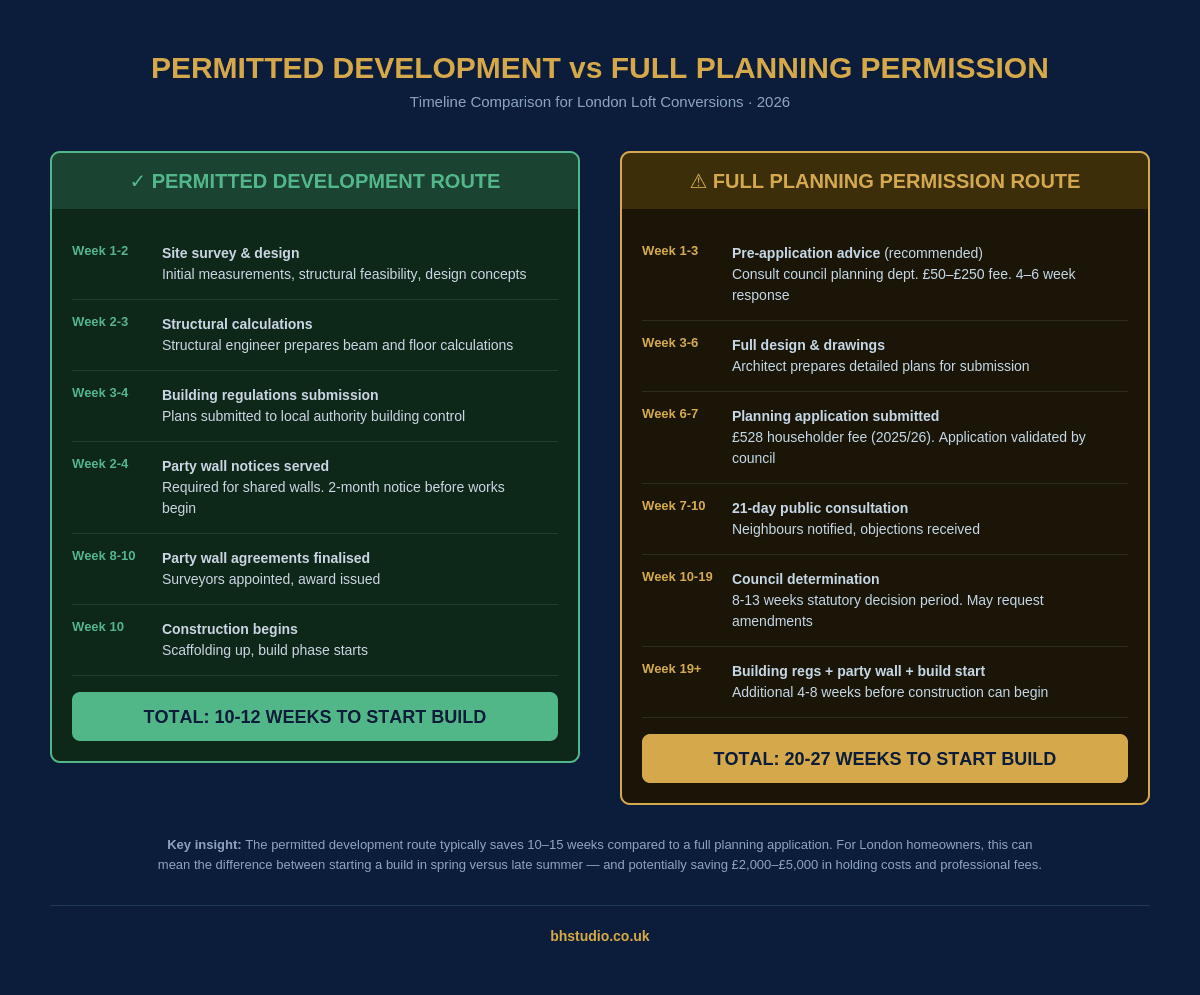
The statutory determination period for a householder planning application is 8 weeks. In practice, many London boroughs take longer - particularly for applications in conservation areas where the conservation officer needs to assess the heritage impact. Expect 8 to 13 weeks for a straightforward application, and potentially longer if the council requests amendments or additional information. If the application is refused, you have the right to appeal to the Planning Inspectorate within 12 weeks of the refusal notice. Appeals can take 3 to 6 months to resolve, which is why getting the application right first time is so important.
How Much Does Planning Permission Cost in 2026?
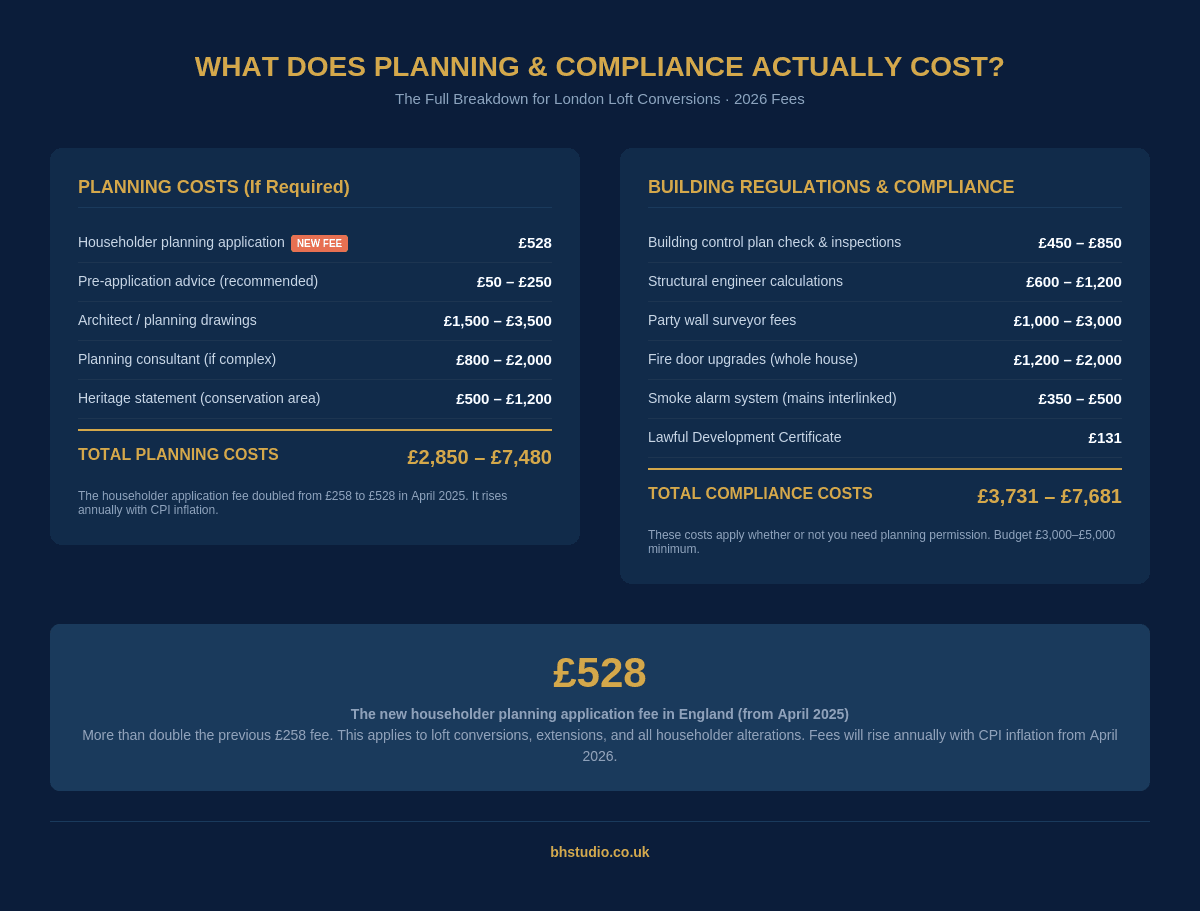
The householder planning application fee in England increased significantly in April 2025, rising from £258 to £528. This fee will increase annually with CPI inflation from April 2026 onwards. The planning application fee is just one component of the total planning cost - you will also need to pay for professional drawings (typically £1,500–£3,500 for a loft conversion), and potentially for pre-application advice from the council (£50–£250), a heritage statement if you are in a conservation area (£500–£1,200), and a planning consultant if your application is complex (£800–£2,000). Total planning costs for a London loft conversion that requires full permission typically range from £2,850 to £7,480.
Building Regulations - Required Regardless of Planning Permission
This is one of the most commonly misunderstood aspects of loft conversions: building regulations approval is required for every loft conversion, whether or not you need planning permission. Planning permission and building regulations are two entirely separate processes. Planning permission deals with the external appearance of your property and its impact on the neighbourhood. Building regulations ensure that the construction work itself is structurally safe, fire-compliant, thermally efficient, and habitable.
The key building regulations that apply to loft conversions cover structural integrity (the existing ceiling joists are not designed to support a habitable room - new floor joists and steel beams are required), fire safety (escape routes must be protected with 30-minute fire-resistant construction, all doors opening onto the staircase must be upgraded to FD20 fire doors, and mains-powered interlinked smoke alarms must be installed on every level), thermal insulation (walls and roof must achieve specific U-values to meet energy efficiency requirements), staircase design (permanent stairs with a maximum pitch of 42 degrees, minimum headroom of 1.9 metres, and compliant handrails), and sound insulation (at least 100mm of sound insulation between new floor joists to reduce noise transfer to rooms below).
Building regulations approval is obtained either through your local authority's building control department or through a private approved inspector. The local authority route typically costs £450–£850 in London, while a private approved inspector costs £950–£1,400 (all-inclusive). Inspections are carried out at key construction stages, and a completion certificate is issued at the end - you must keep this certificate, as it will be required when you sell the property.
Party Wall Agreements - What London Homeowners Must Know
If your loft conversion involves any work on or adjacent to a wall shared with a neighbouring property, you are legally required to serve a party wall notice under the Party Wall etc. Act 1996. This applies to the vast majority of loft conversions on terraced and semi-detached houses in London, where the party wall typically needs to be raised or altered to accommodate the new loft structure.
You must serve notice on your adjoining neighbours at least two months before construction work begins. The notice must include details of the proposed work and copies of your plans. Your neighbour then has 14 days to respond - they can consent (in which case no surveyor is needed), dissent (in which case party wall surveyors must be appointed to produce a party wall award), or fail to respond (which is treated as a dissent).
Party wall surveyor fees in London typically range from £1,000 to £3,000, depending on the complexity of the situation and whether there are disputes. You are usually responsible for paying your neighbour's surveyor fees as well as your own. The party wall award is a legally binding document that sets out the rights and responsibilities of both parties, details the work permitted, records the condition of the neighbouring property before work begins, and provides a mechanism for resolving any damage claims.
Do not confuse party wall agreements with planning permission - they are completely separate processes. You need a party wall agreement regardless of whether your loft conversion requires planning permission or not. At Better Homes, we manage the entire party wall process on behalf of our clients, including drafting and serving notices, coordinating with appointed surveyors, and ensuring all agreements are in place before construction begins.
What Happens If You Build Without Planning Permission?
Building a loft conversion without the necessary planning permission is a serious legal risk that no London homeowner should take. If the council becomes aware that unauthorised development has taken place - through a neighbour complaint, a building control inspection, or during a property sale - it can issue an enforcement notice requiring you to modify or demolish the work.
Enforcement action can be taken for up to ten years after the breach (this time limit was recently extended from the previous four-year period by the Levelling Up and Regeneration Act 2023). The consequences can include demolition of the unauthorised structure at your expense, fines for non-compliance with an enforcement notice, inability to sell your property until the issue is resolved (mortgage lenders will not lend against properties with unresolved planning breaches), and reduced property value even after the issue is addressed.
The cost of demolishing an unauthorised loft conversion and reinstating the original roof structure can easily exceed £30,000–£50,000, far more than the cost of getting the right permissions in the first place. This is why we always recommend either confirming your permitted development status with a Lawful Development Certificate or obtaining full planning permission before any work begins.
Full Cost Breakdown - Planning and Compliance for a London Loft Conversion
Understanding the full picture of planning-related costs helps you budget accurately. Here is a comprehensive breakdown of every fee and professional cost associated with the planning and compliance side of a London loft conversion, based on 2025/26 pricing.
If your loft qualifies for permitted development, your planning-related costs will be minimal: a Lawful Development Certificate (£131), structural engineer calculations (£600–£1,200), building control fees (£450–£850), party wall surveyor fees (£1,000–£3,000 for terraced homes), fire door upgrades throughout the house (£1,200–£2,000), and mains-powered interlinked smoke alarms (£350–£500). Total: approximately £3,700–£7,700.
If you need full planning permission, add the householder application fee (£528), architect or planning drawings (£1,500–£3,500), pre-application advice (£50–£250), and potentially a heritage statement for conservation areas (£500–£1,200) and a planning consultant (£800–£2,000). Total: approximately £6,550–£15,180 when combined with the compliance costs above.
How Better Homes Manages Planning for You
One of the key advantages of working with a full design-and-build firm like Better Homes is that we handle every aspect of the planning and regulatory process as part of our service. Unlike architecture-only firms such as Resi or Extension Architecture, who provide designs but then hand you off to a separate builder, we manage the entire project from initial feasibility assessment through to key handover.
Our process begins with a free site survey where we assess your property's planning status - checking conservation area designations, Article 4 Directions, listed building status, and planning history. If your loft qualifies for permitted development, our in-house design team prepares the technical drawings and we apply for a Lawful Development Certificate on your behalf. If you need full planning permission, our team prepares the planning application, manages the submission process, liaises with the council planning officer, and handles any amendments or conditions.
We also manage building regulations submissions, structural engineering, party wall notices and surveyor coordination, and all construction work. This single-point-of-responsibility model means there are no gaps between the design, planning, and build phases - and no finger-pointing if something goes wrong. It is the most efficient and stress-free way to deliver a loft conversion in London, and it is why our clients consistently rate us among the top loft conversion specialists in East and North London.
Ready to find out whether your property qualifies for permitted development? Get your free loft conversion site survey from Better Homes and we will assess your planning status, discuss your options, and provide a detailed quote - all at no obligation.
Quick Takeaways
1. Most London houses can convert their loft under permitted development - no planning permission needed - if they stay within 40m³ (terraced) or 50m³ (detached/semi) volume limits and follow design rules.
2. London has over 1,000 conservation areas and extensive Article 4 Directions - always check your specific property before assuming permitted development applies.
3. Flats, listed buildings, and conservation area properties almost always require full planning permission for loft conversions.
4. The householder planning application fee is now £528 (from April 2025), and the full planning route adds 10–15 weeks compared to the permitted development route.
5. Building regulations approval is legally required for every loft conversion regardless of planning status, covering structural safety, fire protection, insulation, and staircase design.
6. A Lawful Development Certificate (£131) provides legal proof that your conversion is permitted development - essential when selling your home.
7. Working with a full design-and-build firm eliminates the gaps and delays that occur when architects and builders work separately.
Frequently Asked Questions
Do I need planning permission for a rear dormer loft conversion in London?
In most cases, no. A rear dormer on a standard house outside a conservation area or Article 4 Direction zone will usually qualify for permitted development, provided it stays within the 40m³ (terraced) or 50m³ (detached/semi) volume limit, is set back at least 20cm from the eaves, uses matching materials, and does not exceed the height of the existing roof. If your property is in a conservation area or subject to an Article 4 Direction, you will likely need full planning permission.
How do I find out if my London property is in a conservation area?
Every London borough maintains an interactive conservation area map on its website. Search for "[your borough name] conservation area map" and enter your address. You can also check the London Planning Data Map at apps.london.gov.uk/planning, which shows conservation areas across all 33 boroughs on a single map. Better Homes checks every property's conservation status during our free site survey.
What is the difference between planning permission and building regulations?
Planning permission relates to the external appearance of your property and its impact on the surrounding area - it is about what you are allowed to build. Building regulations are about how you build it - they set legal standards for structural safety, fire protection, insulation, ventilation, and accessibility. You might not need planning permission, but you always need building regulations approval for a loft conversion.
How much does a planning application cost for a loft conversion in 2026?
The householder planning application fee is £528 (as of April 2025, with annual CPI increases from April 2026). Total planning costs, including professional drawings, pre-application advice, and any heritage assessments, typically range from £2,850 to £7,480 for a London loft conversion.
Can I do a loft conversion in a conservation area in London?
Yes, but you will almost certainly need full planning permission. In conservation areas, permitted development rights for roof alterations are restricted or removed entirely. Mansard conversions and rooflight-only conversions tend to receive the most favourable responses from planning officers in conservation zones, as they can be designed to respect the existing streetscape character. A pre-application consultation with your council is strongly recommended.
What is an Article 4 Direction and how does it affect my loft conversion?
An Article 4 Direction is a special order made by a local council that removes specific permitted development rights in a defined area. If your property is subject to an Article 4 Direction that removes Class B rights (roof alterations), you will need full planning permission for your loft conversion, even if it would otherwise qualify as permitted development. Many London boroughs have Article 4 Directions in their conservation areas and other heritage-sensitive locations.
Do I need a party wall agreement for my loft conversion?
If your loft conversion involves work on or near a wall shared with a neighbouring property, yes. This applies to virtually all terraced house loft conversions and most semi-detached conversions in London. You must serve party wall notices at least two months before construction begins. Budget £1,000–£3,000 for party wall surveyor fees, which you are usually responsible for paying.
Found This Guide Useful?
We wrote this guide because navigating London's planning system should not require a law degree. If it helped you understand your options, we would love to hear about it - share it with other London homeowners who are considering a loft conversion. And if you have a specific question about your property that this guide does not cover, get in touch with Better Homes for a free, no-obligation site survey. We will check your planning status, discuss the best conversion type for your home, and give you an honest assessment of costs and timelines. What planning question are you most worried about? Let us know and we will add the answer to this guide.
References
1. Planning Portal - Loft Conversion Planning Permission: planningportal.co.uk/permission/common-projects/loft-conversion/planning-permission
2. GOV.UK - Fees for Planning Applications: gov.uk/guidance/fees-for-planning-applications
3. GOV.UK - Permitted Development Rights for Householders (Technical Guidance): gov.uk/government/publications/permitted-development-rights-for-householders-technical-guidance
4. Historic England - Conservation Areas: historicengland.org.uk/listing/what-is-designation/local/conservation-areas
5. The Town and Country Planning (General Permitted Development) (England) Order 2015, Schedule 2, Part 1, Class B: legislation.gov.uk
Last updated: March 2026. This guide is intended as general information for London homeowners and does not constitute legal or planning advice. For advice specific to your property, consult your local planning authority or a qualified planning professional. Better Homes offers free site surveys that include a full planning status assessment - book yours here.
Want Advice for Your Own Home?
We can help you translate this guidance into a realistic scope and execution plan for your property, whether you're considering a house extension, loft conversion or a full renovation.