
Property buying checklist London 2026: what to check before you buy
Practical London property buying checklist for 2026 covering viewings, surveys, stamp duty, hidden costs, legal process, timeline and negotiation strategy.
How to use this guide
- Read with your project scope and budget envelope in mind.
- Use it to brief designers and compare quotations more rigorously.
- Raise any project-specific constraints with us before committing to a contractor.
Property Buying Checklist London 2026: What to Look for Before You Buy
Buying a property in London in 2026 typically takes 12–26 weeks from first viewing to collecting keys, with total additional costs of £21,000–£28,000+ on a £550,000 purchase (including stamp duty, legal fees, surveys, and insurance). The most important steps are securing a mortgage agreement in principle, commissioning the right RICS survey for your property type - Level 2 for standard homes, Level 3 for Victorian or Edwardian period properties - and budgeting for stamp duty under the April 2025 thresholds, where first-time buyers pay 0% up to £300,000 and standard buyers pay 0% only up to £125,000. This guide covers every stage of the London property buying process, from viewing red flags to exchange and completion.
Key Takeaways
Budget beyond the asking price. Stamp duty, legal fees, surveys, and moving costs add 5–8% on top of the purchase price - on an average London home that means £25,000+ you need in reserve.
Get your mortgage agreement in principle first. London sellers and agents prioritise buyers who can prove they're financially ready. Without an AIP, your offer is less competitive.
Choose the right survey for the property. A Level 2 RICS survey suits most standard-construction homes. For Victorian terraces, Edwardian semis, or any property over 80 years old, invest in a Level 3 structural survey - it could save you tens of thousands in unexpected repairs.
Know the London-specific pitfalls. Leasehold traps, conservation area restrictions, Article 4 Directions, Japanese knotweed, and basement underpinning on your street can all affect value and liveability in ways that don't apply outside the capital.
Viewing with intent is a skill. Look past the staging - check the roof line, test water pressure, open every window, and ask why anything looks newly painted. The red flags you catch at viewing stage save you time and money later.
Use your survey findings to negotiate. In the current London market, survey issues give you genuine leverage to renegotiate the price or request repairs before exchange.
Think renovation potential. Properties that need cosmetic or structural work are often the best value plays in London - a loft conversion, rear extension, or full renovation can add 15–25% to the property's value.
What This Guide Covers
How to Prepare Your Finances Before You Start Searching
The London property market rewards prepared buyers. With average property prices exceeding £530,000 and transaction timelines that commonly stretch beyond four months, the financial groundwork you do before viewing a single property determines whether you can act decisively when the right home appears - or whether you lose it to someone who can.
Mortgage Agreement in Principle
A mortgage agreement in principle (AIP) is a conditional confirmation from a lender that they would, in theory, lend you a specific amount. It is not a guarantee - the lender will still conduct a full underwriting assessment once you make a formal application - but it serves two critical purposes. First, it forces you to understand exactly what you can afford, taking into account your income, existing debts, and the deposit you have available. Second, it signals to estate agents and sellers that you are a credible buyer. In a market where London properties can attract multiple offers within days of listing, this credibility matters.
To get an AIP, you'll typically need three months of payslips or two years of accounts if you're self-employed, three to six months of bank statements, proof of your deposit, and identification documents. Most brokers can arrange an AIP within 24–48 hours, and it usually remains valid for 60–90 days. Using an independent whole-of-market mortgage broker rather than a single lender's in-house advisor gives you access to a wider range of products and can save thousands over the mortgage term.
Understanding Your True Budget
Your budget is not just what the lender will give you plus your deposit. It's that figure minus the substantial additional costs of buying in London. Most lenders cap borrowing at 4–4.5 times your gross annual income, and the affordability assessment stress-tests your ability to pay if rates rise. For a household earning £100,000, that typically means a maximum mortgage of £400,000–£450,000. Add a 10% deposit of £50,000, and your headline budget is around £450,000–£500,000. But from that, you need to subtract stamp duty (potentially £12,500+ for a home mover at £500,000), legal fees (£1,800–£3,500), survey costs (£400–£1,500), and several thousand more for moving, insurance, and immediate works. The rule of thumb is to keep 5–8% of the purchase price in reserve for these costs, plus an emergency fund of at least three to six months of essential outgoings.
If you are a first-time buyer, there are advantages worth exploiting. Lifetime ISAs allow you to save up to £4,000 per year with a 25% government bonus, applicable to properties up to £450,000. First-time buyer stamp duty relief means you pay nothing on the first £300,000 of properties costing up to £500,000 - a meaningful saving in the London context. And because you have no chain, you are a more attractive buyer to sellers, which can work in your favour during negotiations.
The Complete Property Viewing Checklist
A property viewing is not a social visit - it's an inspection. You are trying to identify whether this property is structurally sound, fairly priced, suitable for your needs, and located in an area where you'll want to live for the next five to ten years. The staging, the freshly baked bread smell, the carefully angled photographs - all of that is designed to make you feel something. Your job is to look past it and see the property as it really is. Research from the HomeOwners Alliance found that 37% of homeowners regret aspects of the home they bought, and the most common regrets involve things that could have been spotted or asked about during the viewing.
Structural and External Checks
Before you even walk through the front door, stand across the street and look at the property from a distance. Is the roofline straight or does it dip and sag? Are the chimney stacks vertical? Do the walls appear plumb or do they lean or bow? Diagonal cracks running from the corners of windows or doors are classic indicators of subsidence, and stepped cracks following the mortar joints can signal foundation movement. Neither of these are necessarily deal-breakers, but they need professional assessment before you commit.
Check the gutters and downpipes - are they in good condition or cracked and overflowing? Blocked or broken gutters are one of the most common causes of penetrating damp in London period properties, and the repair itself is relatively inexpensive, but the damp damage it causes can run into thousands. Look at the pointing between bricks: if the mortar is crumbling or has been patched with cement (common in Victorian houses that originally used lime mortar), moisture can become trapped inside the walls. Walk around the entire exterior if you can, and compare the property to its neighbours - if every house on the street has had its roof replaced except this one, that's a question worth asking.
Interior and Damp Assessment
Inside, engage all your senses. Can you smell damp or mustiness? Feel the walls at low level - are they cold and clammy? Look for tide marks, bubbling plaster, peeling wallpaper, or dark patches in the corners of rooms and behind radiators. In Victorian and Edwardian London homes, solid walls without cavities are the norm, which makes them inherently more susceptible to both rising and penetrating damp than modern cavity wall construction.
Check the ceilings for brown water stains - these indicate past or current leaks from above, whether from the roof, bathroom plumbing, or a failed seal. Ask the seller directly: has the property ever had damp treatment, and if so, when and by whom? Reputable damp proofing typically comes with a transferable guarantee that protects subsequent owners. Try opening and closing windows and doors throughout the property. Sticking doors can indicate structural movement, though in older timber-framed properties some seasonal movement is normal. If multiple doors stick or frames appear racked, get a surveyor to investigate.
Services and Systems
The consumer unit (fuse box) tells you a lot about a property's electrical condition. If you see an old-style rewirable fuse box without RCDs (residual current devices), the wiring is almost certainly outdated and potentially dangerous. Rewiring a typical London terraced house costs £5,000–£12,000 depending on size and complexity, and it's disruptive work that requires lifting floorboards and chasing walls. Ask to see an Electrical Installation Condition Report (EICR) - if the seller doesn't have one, it's reasonable to factor rewiring into your offer.
Run the hot and cold taps, flush the toilet, and if possible turn on the shower. Low water pressure might be caused by old lead supply pipes (still present in many London properties built before 1970), corroded internal pipework, or a shared supply that struggles at peak times. Check the boiler - most gas boilers last 12–15 years, and replacement costs £2,500–£5,000+. Ask for the Gas Safety Certificate and check its date. Finally, look at the Energy Performance Certificate (EPC) rating. London's Victorian housing stock frequently sits at Band D or below, which means higher energy bills and potential future implications as minimum energy efficiency standards tighten. Upgrading from Band D to Band C can cost £6,000–£15,000 for a solid- walled period property.
The Neighbourhood Factor
Visit the area at different times of day - morning rush hour, school pick-up time, Friday evening. What sounds can you hear from inside the property? Is there aircraft noise, railway vibration, or heavy road traffic? These are things you cannot change. Check mobile phone signal and broadband speed (Ofcom's online checker provides this data by postcode). Research local crime statistics on police.uk. If you have children or plan to, look at Ofsted ratings for nearby schools and the catchment area boundaries - in London, being 200 metres inside or outside a popular school's catchment can affect property values by 10–15%.
Look at the planning portal for the local council. Are there any proposed developments nearby that could affect your view, your light, or your street's character? Is the property in a conservation area? If so, permitted development rights may be restricted, limiting what you can do to extend or alter the property without planning permission. In London, 32 boroughs have areas covered by Article 4 Directions that remove standard permitted development rights - this is particularly relevant if you're buying with plans to extend or convert the loft in the future.

Which House Survey Do You Actually Need?
A house survey is one of the most important investments you make during the buying process, and yet it's one of the costs buyers most commonly try to avoid. The survey gives you an independent, professional assessment of the property's condition - information that no amount of careful viewing can replicate, because a qualified surveyor knows what to look for behind the surfaces. In London, where property prices are high and period properties are the norm, the financial consequences of skipping a survey or choosing the wrong level can be severe.
RICS Level 1, 2, and 3 Compared
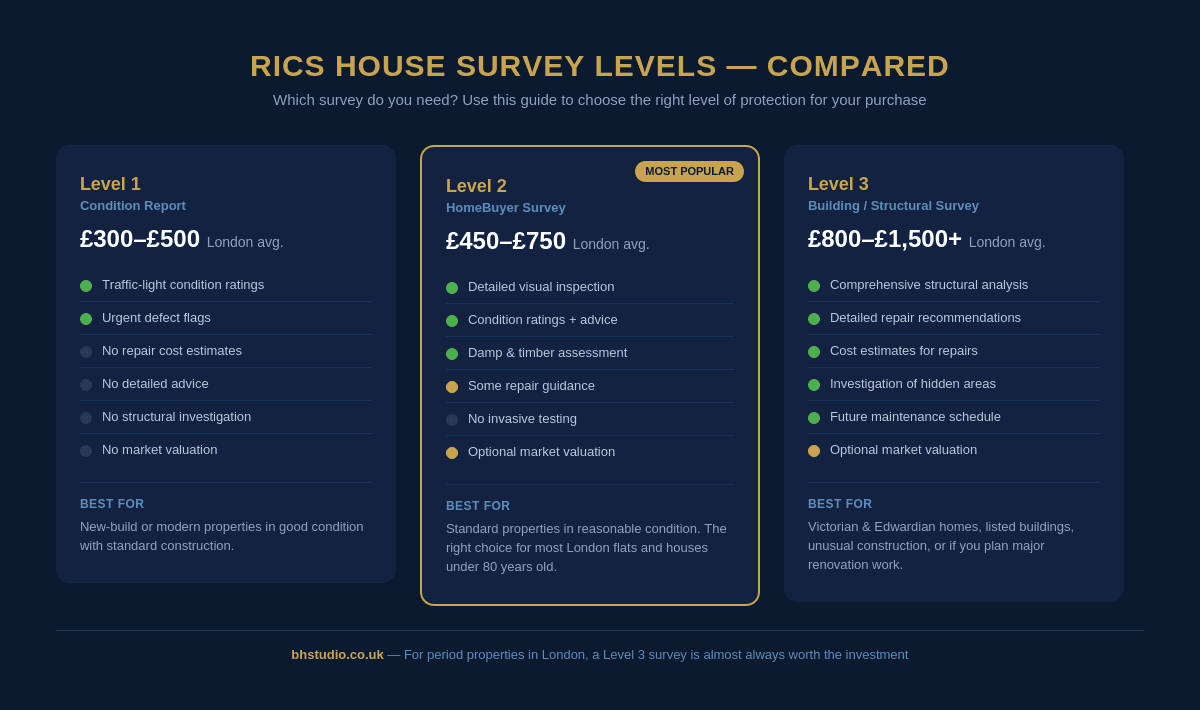
The Royal Institution of Chartered Surveyors (RICS) standardised residential surveys into three levels in 2021. A Level 1 survey (previously called a Condition Report) is the most basic - a traffic- light system flagging visible defects without advice on causes or remedies. It costs £300–£500 in London and suits new-build or modern properties in visibly good condition. A Level 2 survey (previously the HomeBuyer Report) is the most commonly commissioned level and provides a detailed visual inspection with condition ratings, damp and timber assessment, and general repair guidance. It costs £450–£750 in London and is appropriate for standard-construction properties in reasonable condition. A Level 3 survey (previously the Building Survey or Full Structural Survey) is the most comprehensive, offering a thorough structural analysis with detailed repair recommendations, cost estimates, and a future maintenance schedule. London costs range from £800 to £1,500+.
Why Period Properties in London Deserve a Level 3
If you're buying a Victorian terraced house in Hackney, an Edwardian semi in Muswell Hill, or a Georgian conversion in Islington, a Level 3 survey is almost always the right choice. These properties commonly have shallow foundations that can be susceptible to subsidence, solid walls prone to damp, original timber floors that may have suffered from poor sub-floor ventilation, and roofs that have been patched and repaired over more than a century of use. The difference in cost between a Level 2 and a Level 3 survey - typically £300–£500 - is negligible compared to the tens of thousands of pounds you could face in undiscovered structural repairs.
A Level 3 survey also gives you powerful negotiating leverage. If the report identifies significant defects, you have a documented, impartial basis for renegotiating the price. According to multiple surveying firms, nearly a third of buyers who commission a survey take action as a result of issues flagged - whether that's renegotiating the price, requesting the seller carry out repairs before exchange, or in some cases walking away from the purchase entirely.
Stamp Duty in London 2026 - What You'll Really Pay
Stamp Duty Land Tax (SDLT) is one of the largest upfront costs of buying a property in England and Northern Ireland, and in London - where the average property price exceeds £530,000 - it can add tens of thousands to your purchase. Following the April 2025 threshold changes, buyers are now paying more than they were during the temporary relief period. Understanding the current rates is essential for accurate budgeting.
First-Time Buyer Relief
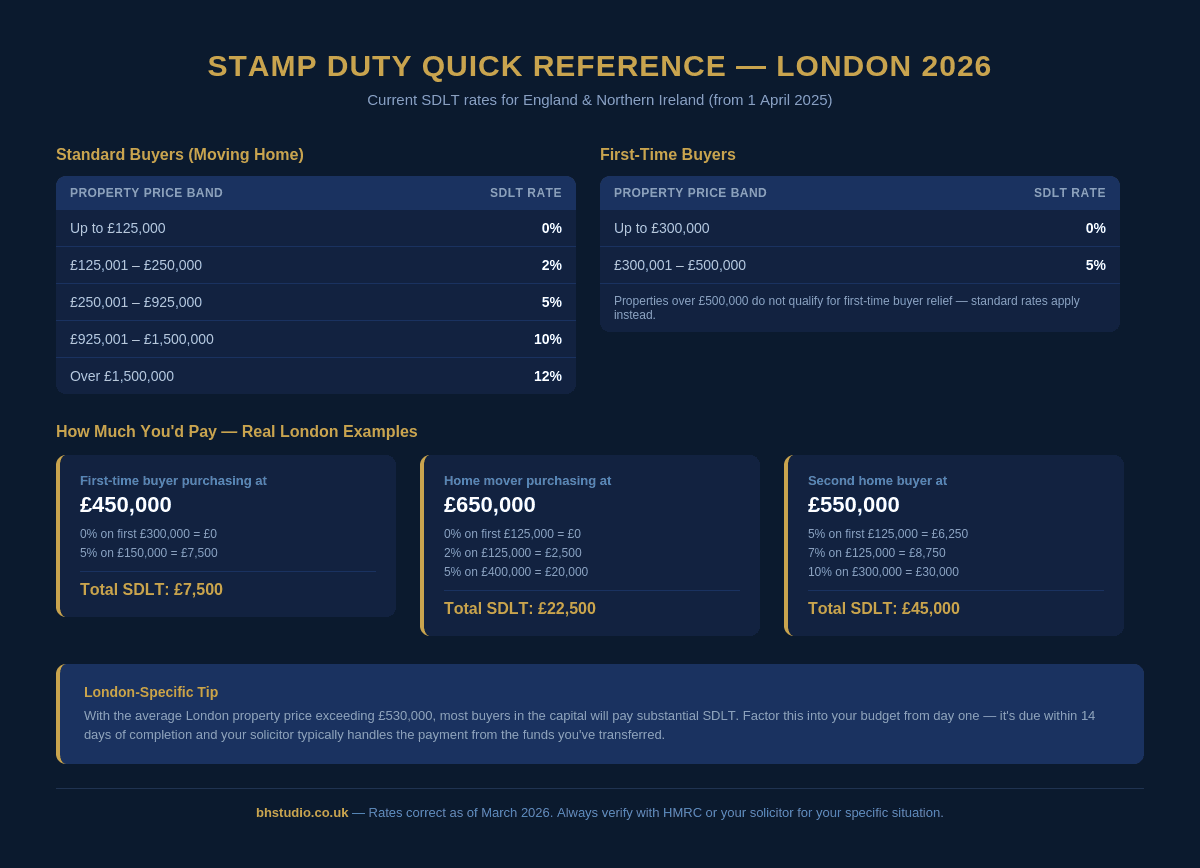
If you've never owned property in the UK or abroad, you qualify for first-time buyer relief. Under the current rules (in effect from 1 April 2025), you pay 0% stamp duty on properties up to £300,000, and 5% on the portion between £300,001 and £500,000. If the property costs more than £500,000, you do not qualify for first-time buyer relief at all, and you pay the standard rates from the first pound. This is a critical threshold in London, where many properties - even two-bedroom flats in Zone 2 - exceed £500,000. A first-time buyer purchasing at £480,000 would pay £9,000 in SDLT. One purchasing at £520,000 would pay £15,500, because they've crossed the £500,000 ceiling and lose the relief entirely.
Home Movers and Second Properties
Standard buyers (people selling one home to buy another) pay 0% on the first £125,000, 2% on the portion from £125,001 to £250,000, 5% from £250,001 to £925,000, 10% from £925,001 to £1,500,000, and 12% above that. For a £650,000 London home - a fairly typical family purchase in areas like Walthamstow, Crouch End, or Finchley - a home mover would pay £22,500 in stamp duty. Buyers of additional properties (second homes, buy-to-let investments) face a 5% surcharge on top of the standard rates, making the tax burden substantially higher. An additional-property buyer at £550,000 would pay approximately £45,000. Non-UK residents pay a further 2% on top of all applicable rates.
The Hidden Costs Every London Buyer Forgets
Stamp duty gets the headlines, but it's the accumulation of smaller costs that catches most buyers off guard. When you add conveyancing fees, survey costs, mortgage arrangement fees, buildings insurance, removal costs, and immediate maintenance or decorating expenses, the total additional outlay on a typical London purchase can easily reach £21,000–£28,000 or more, depending on the property price and your specific circumstances.
Conveyancing - the legal work of transferring property ownership - costs £1,800–£3,500+ in London. This covers your solicitor's or licensed conveyancer's time, local authority searches (which check for planning issues, environmental risks, road schemes, and other matters affecting the property), Land Registry fees, and bank transfer charges. London transactions tend to be more expensive because property values are higher (many solicitors charge a percentage), leasehold properties require additional enquiries, and the legal complexity of London property - conservation areas, listed buildings, shared freeholds - adds to the workload.
Mortgage arrangement fees can run from £0 to £2,000 depending on the product. Some of the lowest interest rate deals come with high arrangement fees, and it's important to calculate the total cost over the mortgage term rather than fixating on the headline rate. Your broker should model this for you. Removal costs in London are higher than the national average because of congestion charges, parking permits, narrow access, and often the need for specialist equipment to navigate flights of stairs in period properties. Budget £800–£2,500 depending on the size of your move and whether you need packing services.
Don't forget the costs that hit after completion. Redirection of post (£53.50 for three months via Royal Mail), updating council tax, utility transfers, and - for most buyers of period property - the immediate works that you knew about but agreed to absorb: a boiler service, gutter clearance, lock changes, and the inevitable "we'll just do the kitchen first" that turns into a six-month renovation project.

Leasehold vs Freehold - What London Buyers Must Know
In London, a significant proportion of properties - particularly flats, maisonettes, and converted period houses - are sold leasehold. This means you own the right to live in the property for a set number of years (the lease term), but you do not own the building or the land it sits on. The freeholder does. Understanding the implications of leasehold ownership is essential for any London buyer, because the lease terms directly affect your property's value, mortgageability, and your ongoing costs.
The lease length is the single most important factor. A lease with more than 90 years remaining is generally considered acceptable by most lenders and will not significantly affect the property's value. Below 80 years, many mortgage lenders become reluctant to lend, and the cost of extending the lease increases substantially - this is because the closer a lease gets to 80 years, the more expensive the extension becomes due to a factor called "marriage value," which gives the freeholder a share of the uplift in property value that the extension creates. If you're considering a leasehold property, always check the remaining lease length, the current ground rent and any escalation clauses, the annual service charge (which in central London apartment blocks can range from £2,000 to £6,000+ per year), the reserve fund balance, and whether any major works are planned under Section 20.
Your solicitor should request an LPE1 form (Leasehold Property Enquiry form) from the managing agent, which contains all of this information. Be wary of ground rent clauses that double every 10 or 25 years - while new legislation has capped ground rent on new leases at a peppercorn (essentially zero), existing leases may still contain escalating clauses that can make the property difficult to sell in the future. If you have the opportunity to buy a share of the freehold alongside other leaseholders, this gives you collective control over the building's management and is generally considered a significant advantage.
How to Negotiate After the Survey
Receiving your survey report can feel daunting - even well-maintained properties will have items flagged, and the language surveyors use ("further investigation recommended," "significant defect noted") can sound alarming when you're emotionally invested in the purchase. The key is to separate the cosmetic from the structural, and the manageable from the deal-breaking.
Start by categorising the findings. Urgent structural issues - subsidence, significant damp penetration, asbestos, roof failure - are the items that most justify either a price reduction or a request for the seller to commission repairs before exchange. Get quotes from contractors for the cost of remediation and present these to the seller's agent with a clear, evidence-based renegotiation. In the current London market, where properties are taking an average of 60–75 days to sell (compared to around 40 days during the 2021 peak), sellers are generally more open to negotiation than they were two years ago. A reasonable approach - "the survey has identified X, which we've been quoted £Y to fix, and we'd like to discuss adjusting the price accordingly" - is far more likely to succeed than threatening to pull out.
Less critical items - routine maintenance, cosmetic wear, dated kitchens or bathrooms - are generally not grounds for price renegotiation, because you should have factored these into your offer based on the viewing. However, if the survey reveals that the boiler is condemned, the electrics need rewiring, or there's an undisclosed planning issue, these are legitimate points to raise. Your solicitor can formally raise enquiries based on the survey findings, and the seller is legally obligated to respond honestly through the Property Information Form (TA6).
Conveyancing and the Legal Process Explained
Conveyancing is the legal process of transferring property ownership from the seller to the buyer, and it's handled by a solicitor or a licensed conveyancer acting on your behalf. The process typically takes 8–14 weeks in London, though complex chains or leasehold complications can extend this significantly. Your conveyancer is your legal representative in the transaction - they protect your interests by ensuring that the property you're buying is exactly what it's represented to be.
Local Authority Searches
One of the most important things your conveyancer does is commission local authority searches. These reveal information that could materially affect your use and enjoyment of the property, including planning applications near the property (proposed developments, road widening schemes, compulsory purchase orders), environmental reports (flood risk, contaminated land, radon levels), tree preservation orders, conservation area status, and building control history. In London, these searches are particularly important because of the density of development, the prevalence of conservation areas, and the ongoing infrastructure projects (Crossrail 2, the Bakerloo line extension, major regeneration schemes) that can affect both value and livability. The searches cost £250–£400 and take 2–6 weeks to return, depending on the borough.
Exchange and Completion
The exchange of contracts is the point at which the purchase becomes legally binding. Before exchange, either party can withdraw without penalty (a practice known as gazumping when the seller accepts a higher offer, or gazundering when the buyer reduces their offer at the last minute). At exchange, you pay your deposit - usually 10% of the purchase price - and agree a completion date, which is typically 1–4 weeks later. Completion is the day when the remaining funds are transferred, the seller vacates, and you collect the keys. Your solicitor will handle the stamp duty payment (which must be made within 14 days of completion) and register the change of ownership with the Land Registry.
Between exchange and completion, you should arrange buildings insurance (you become responsible for the property from exchange, even though you don't own it yet), finalise your removals, notify utility providers, and set up your council tax account with the relevant London borough. Do not cancel your current rental agreement or sell your existing property's contents until after completion - property transactions can and do collapse at the last minute, and you need to protect your position until the keys are in your hand.
Victorian and Edwardian Properties - London-Specific Pitfalls
London's housing stock is overwhelmingly Victorian and Edwardian. Across the boroughs where most family homes are located - Hackney, Islington, Walthamstow, Muswell Hill, Crouch End, Finchley - period terraced houses and semi-detached properties account for 60–75% of available housing. These homes are beloved for their high ceilings, generous proportions, original features, and solid construction. But they come with a specific set of challenges that every buyer should understand before committing.
Damp is the most prevalent issue. Victorian properties were built with solid masonry walls - typically London stock brick with no cavity - and many were originally constructed without any damp-proof course. Over 150+ years, rising damp from the ground, penetrating damp through aging mortar joints, and condensation from reduced ventilation (caused by blocked chimneys, replaced windows, and sealed sub-floor voids) have become endemic. The good news is that most damp issues are treatable; the important thing is to understand the cause before spending money on a solution. A surveyor with experience in period properties can distinguish between the different types and advise on appropriate remediation.
Structural movement is common but not always cause for alarm. Victorian terraces typically have shallow strip foundations, and in London's clay soils, seasonal shrinkage and swelling can cause minor cracking. The key question is whether the movement is historic (it happened years ago and has stabilised) or progressive (it's still occurring). Monitoring tells, insurance reports, and your surveyor's assessment will guide this. Subsidence underpinning - which addresses foundation failure - costs £10,000–£50,000+ and can affect insurance premiums for years, so understanding the building's movement history is critical.
Outdated electrical systems are found in the majority of unrenovated Victorian homes. Original knob-and-tube wiring has long been replaced in most properties, but many still have 1960s or 1970s rewiring that lacks modern safety features. Lead water supply pipes are still present in many London properties built before 1970 - your water supplier can test your water for lead content and may offer free pipe replacement under certain circumstances. Roof timbers in Victorian terraces were often undersized by modern standards, and where original lightweight slate tiles have been replaced with heavier concrete tiles, the additional weight can cause sagging and failure over time.
Energy efficiency is typically poor. Victorian homes tend to receive EPC ratings of D, E, or below, resulting in higher annual energy costs. Upgrading a solid-walled Victorian property to a reasonable level of thermal efficiency - through internal or external wall insulation, loft insulation, double glazing, and boiler replacement - can cost £6,000–£15,000 or more, but it also adds value and reduces running costs significantly. If you're planning a renovation, incorporating energy improvements into the project is almost always more cost- effective than retrofitting them separately.
The Complete London Property Buying Timeline
Understanding the typical timeline helps you plan your move, manage your expectations, and avoid the frustration that comes from thinking the process will be faster than it is. In London, the average purchase takes 12–26 weeks from first viewing to collecting keys, though complex chains, leasehold complications, or difficult searches can push this out further.
The process begins with getting your mortgage agreement in principle (week 1–2), then searching and viewing properties (weeks 2–8). Once your offer is accepted (a moment that typically comes after 5–15 viewings in London), you instruct your solicitor and commission your survey (weeks 8–10). The survey, searches, and legal due diligence run concurrently and take 6–10 weeks - this is often the slowest part of the process and the stage where buyers feel most frustrated. Your formal mortgage offer is issued (weeks 16–20), and once all enquiries are satisfied and contracts are agreed, you exchange (weeks 18–22). Completion follows 1–4 weeks later, and you collect your keys.

How to Spot Renovation Potential and Add Value
In a market where finished, fully renovated homes command premium prices, buying a property that needs work can be one of the smartest strategies for London buyers - provided you understand the costs, timelines, and planning constraints involved. The properties that offer the greatest value-add potential are those with poor cosmetic condition (which deters less experienced buyers), unused space that can be converted (lofts, basements, side returns), and outdated layouts that can be reconfigured for modern living.
Loft conversions are one of the most effective ways to add value to a London property. A rear dormer conversion on a Victorian terrace typically costs £45,000–£75,000 and can add 20–25% to the property's value - meaning a £60,000 investment on a £550,000 Hackney terrace could add £110,000–£137,000 in value. Most rear dormers fall within permitted development rights, meaning you don't need planning permission (though this doesn't apply in conservation areas or Article 4 Direction zones). Rear and side return extensions are equally powerful, with single-storey rear extensions up to 4 metres on terraced properties typically qualifying for permitted development.
When viewing a property with renovation potential, check the roof space (is there sufficient head height for a conversion?), look for the side return (is there an alleyway beside the kitchen that could become part of an open-plan living space?), and assess the garden (is there room for a rear extension without losing all outdoor space?). Think about whether the property's orientation means a rear extension would face south - this dramatically affects how much natural light the new space receives. If you're considering a property specifically for its renovation potential, working with a design-and-build firm from the outset - one that handles architecture, planning, and construction under a single contract - eliminates the coordination risk that comes from managing separate architect and builder relationships.
At Better Homes, we work with homeowners across East and North London who have bought properties specifically for their renovation potential. Our design-and-build model means we can assess a property's potential during the viewing stage, provide realistic cost estimates before you make an offer, and deliver the full project from architectural design through to final handover. If you're buying a property with plans to renovate, extend, or convert, we'd welcome a conversation about what's possible - get in touch at bhstudio.co.uk/contact for a free initial consultation.
Frequently Asked Questions
How much deposit do I need to buy a house in London?
You need a minimum of 5% of the purchase price, but 10–15% will give you access to better mortgage rates and make your offer more competitive. On a £500,000 London property, that means saving £25,000–£75,000 for the deposit alone, plus £25,000–£40,000 for additional buying costs. Most lenders cap borrowing at 4–4.5 times your gross annual income.
Is a house survey legally required when buying in England?
No - there is no legal requirement in England, Wales, or Northern Ireland for a buyer to commission a survey. However, it is strongly recommended. Your mortgage lender will require a basic valuation (which they arrange), but this only confirms the property is worth what you're paying - it does not check for structural defects, damp, or other issues. A RICS survey is your protection against hidden problems that could cost thousands to fix.
What is the average time to buy a property in London?
The typical timeline from accepted offer to completion is 12–18 weeks, though the total time from starting your search to collecting keys averages 16–26 weeks. Factors that slow the process include long property chains, leasehold complications requiring additional enquiries, slow local authority searches (some London boroughs take 4–6 weeks), and delays in mortgage underwriting.
How much does conveyancing cost in London?
Conveyancing fees in London typically range from £1,800 to £3,500+ including disbursements (searches, Land Registry fees, bank transfer charges). Leasehold transactions are more expensive than freehold because they require additional enquiries. Some solicitors charge a percentage of the property price, while others charge a fixed fee. Always get a detailed quote that includes all disbursements before instructing.
Can I negotiate the house price after a survey in the UK?
Yes, and it's common practice. If your survey reveals significant issues - structural defects, damp, a condemned boiler, asbestos, outdated electrics - you have legitimate grounds to renegotiate. The most effective approach is to get contractor quotes for the required work and present these to the seller's agent as the basis for a price reduction. In the current market, with longer selling periods and more stock available, sellers are generally open to reasonable negotiation.
What should I check on a leasehold property in London?
Check the remaining lease length (below 80 years is a red flag for mortgageability and value), the ground rent amount and any escalation clauses, annual service charges, the reserve fund balance, whether any major works are planned under Section 20, and who the freeholder and managing agent are. Request an LPE1 form through your solicitor. If the lease is below 80 years, factor in the cost of a lease extension (which can be significant) before making your offer.
How much does stamp duty cost on a £600,000 London house in 2026?
For a standard buyer (selling their current home), stamp duty on a £600,000 property is £20,000. For a first-time buyer, the first-time buyer relief does not apply because the property exceeds £500,000, so they would also pay £20,000. For an additional property buyer, the total including the 5% surcharge would be approximately £38,000.
Ready to Buy? Here's What to Do Next
Buying a property in London is one of the largest financial commitments you'll ever make - and it's one that rewards preparation, patience, and professional advice over impulse. The buyers who navigate the process most successfully are those who understand their budget before they start searching, choose the right level of survey for the property they're buying, know what to look for during viewings, and build a team of trusted professionals - mortgage broker, solicitor, surveyor - before they need them.
If you're buying a property with renovation potential - or if you've already purchased and you're ready to transform it - Better Homes is a full design-and-build firm specialising in loft conversions, house extensions, and complete home renovations across East and North London. We handle everything from architectural design and planning permission through to construction and final handover, with fixed-price contracts, a 10-year workmanship guarantee, and £10M insurance cover.
Whether you're exploring what's possible before you buy, or you're ready to start work on a property you already own, get in touch for a free consultation.
Found This Useful? Share It
If this guide has helped you feel more prepared for your London property purchase, share it with someone else who's going through the same process. Buying a home is easier when you know what to expect - and harder when you don't. We'd also love to hear from you: what's the one thing you wish you'd known before buying your first property in London? Drop us a message at bhstudio.co.uk/contact - we read every one.
References
1. Royal Institution of Chartered Surveyors (RICS) - House Surveys: Costs, Types and Benefits
2. HM Revenue & Customs - Stamp Duty Land Tax Rates and Thresholds
3. HomeOwners Alliance - Step-by-Step Guide to Buying a House
4. MoneyHelper (formerly Money Advice Service) - Stamp Duty Calculator and Guide
5. UK Government Planning Portal - Planning Permission and Permitted Development Rights
Want Advice for Your Own Home?
We can help you translate this guidance into a realistic scope and execution plan for your property, whether you're considering a house extension, loft conversion or a full renovation.